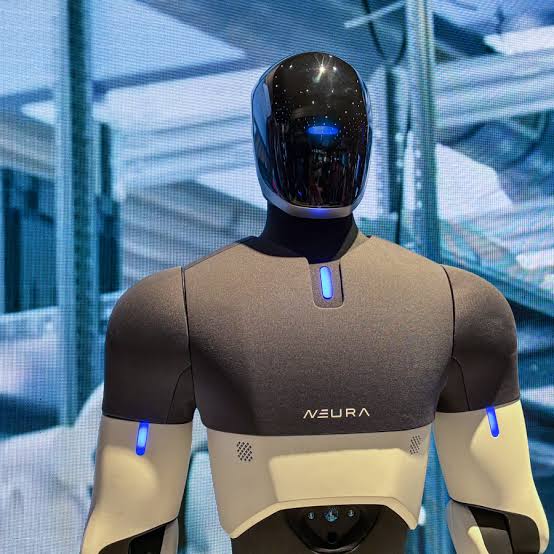
Robot Security Guards Are Here: What Humanoid Guards and AI-Powered Quadruped Robots Mean for Security in 2026 and Beyond
Ten years ago, a robot security guard sounded like science fiction. In 2026, quadruped robots are patrolling World Cup stadiums, data centers and apartment complexes, and robotics companies are selling humanoid robots built specifically for guard duty.
So are robots about to replace security officers? And if you manage a construction site, warehouse, retail store or manufacturing plant, should you be planning for a robot instead of a guard?
As a local security company in the Portland area, we follow this technology closely, because our clients ask about it. Here’s an honest look at what security robots can actually do today, the rules that govern them, and when we expect the security industry to make the shift.
The Three Types of Security Robots on the Market Today
Not all security robots are the same. Right now, they fall into three main categories.

1. Wheeled Patrol Robots
These are the most established security robots. They look like large rolling kiosks or pods and patrol parking lots, malls, corporate campuses and garages on a set or randomized route.
Knightscope is the best-known name. The California company reports serving 434 clients across 42 states, and its robots have logged more than 4.4 million hours of autonomous patrol. Its newest outdoor robot, the K7, was expected to begin initial deployments in late 2026. In February 2026, Knightscope also bought a traditional human guard company, Event Risk, and is now combining robots, software and human officers into what it calls an “Autonomous Security Force.”
Closer to home, Oregon-based Daxbot builds smaller patrol robots that private security firms use for mobile video monitoring and site patrols. One recently began patrolling the Salem Center mall.
What they do well: steady, predictable patrols of flat, open areas; recording video; reading license plates; and alerting a human monitoring team when something looks wrong.
Where they struggle: stairs, gravel, mud, tight spaces and anything that requires judgment or physical intervention.
2. AI-Powered Quadruped Robots
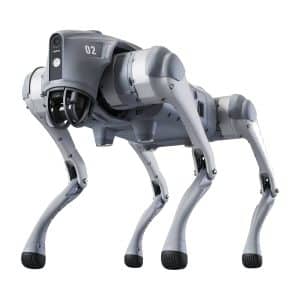
AI-powered quadruped robots, the four-legged machines often nicknamed “robot dogs,” solve the terrain problem. They can climb stairs, walk over gravel and uneven ground, and get into spaces wheeled robots can’t reach.
This was a breakout year for them:
- The 2026 FIFA World Cup used quadruped robots from Boston Dynamics, Unitree and DEEP Robotics to patrol and inspect areas at stadiums in the U.S. and Mexico.
- Data centers are paying as much as $175,000 per Boston Dynamics or Ghost Robotics unit to patrol fence lines and catch faulty equipment.
- In Atlanta, a private security company began running quadruped robot patrols at apartment complexes in 2026, which sparked both praise from residents and concern from privacy advocates.
- Lower-cost options are arriving fast. Security companies are now building patrol packages on Unitree quadrupeds with HD, thermal and infrared cameras plus LiDAR navigation.
What they do well: perimeter patrols on rough terrain, thermal inspections, reaching hard-to-access areas, and acting as a mobile camera for a remote operator.
Where they struggle: battery life, weather, high upfront cost, and they still can’t make decisions, talk a situation down or physically stop anyone.
3. Humanoid Security Robots
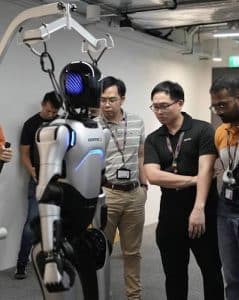
Humanoid robots, built roughly in the shape of a person, are the newest and most hyped category.
In October 2026, Unitree unveiled the H2-X, a 1.8-meter (about 5’11”) humanoid marketed for guard and rescue work. The launch video showed it landing a jump from a 4-meter platform, staying balanced after impacts, and staging a demo where it steps between a person and a mock intruder. It has about 8 hours of standing endurance. The base H2 model it’s built on sells for about $29,900.
In the U.S., Robotic Assistance Devices (RAD) introduced a humanoid called HERO (Humanoid Enforcement & Response Officer) designed to stand post at gates and act as a security and emergency response unit, alongside its ROAMEO wheeled patrol robot. Knightscope is also prototyping a humanoid-style unit, the H1.
But even tech reviewers note that humanoid guards aren’t quite ready for real security work yet. Most of what you see online is a carefully staged demo, not a robot working a 12-hour overnight shift on a muddy jobsite.
What Robots Can (and Can’t) Do Compared to a Human Officer
| Task | Robots Today | Licensed Human Officer |
|---|---|---|
| Patrol a set route 24/7 | ✅ Excellent | ✅ Yes, with shift coverage |
| Record video, thermal and license plates | ✅ Excellent | ⚠️ Limited to body cam and reports |
| Climb stairs and rough terrain | ⚠️ Quadruped robots only | ✅ Yes |
| Check IDs and use judgment at a gate | ❌ Very limited | ✅ Yes |
| De-escalate an upset person | ❌ No | ✅ Yes |
| Give first aid or help in an emergency | ❌ No | ✅ Yes |
| Physically intervene or detain | ❌ No (and restricted by law in some states) | ✅ Within the law and post orders |
| Adapt to something new and unexpected | ❌ Poor | ✅ Yes |
| Work in heavy rain, snow or ice | ⚠️ Unreliable | ✅ Yes |
The pattern is clear: robots are excellent sensors. Humans are still the responders. A robot can spot someone climbing your fence at 3 AM. It can’t talk them down, check whether they’re a subcontractor who forgot their badge, or help a worker who’s been hurt.
Current Rules and Regulations for Security Robots
The law is still catching up with the technology, but a clear direction is forming. Here’s where things stand as of late 2026.
Weaponized Robots Are Being Banned
The biggest legal trend is a push to keep weapons off robots.
- Massachusetts: In 2026, the Massachusetts House passed a bill 155–1 that would ban making, selling, possessing or operating a robot equipped with a weapon, including guns, explosives, weaponized lasers and chemical irritants. It would also ban using robots to threaten, harass or physically restrain people, and would require police to get warrants before sending robots onto private property for surveillance. Boston Dynamics and other robotics groups publicly supported it.
- New York: Lawmakers have proposed similar legislation that would ban civilians from weaponizing robots, and the New York City Council introduced the “Asimov Act” to keep the NYPD from using armed robots.
- California: State lawmakers have introduced measures to prohibit weaponized robots and drones.
- Oregon: Oregon already bans weaponized drones under a law that took effect in 2017, and it limits police drone surveillance.
The major robot makers, including Boston Dynamics, have also pledged not to put weapons on their general-purpose robots.
Restrictions on Foreign-Made Robots
In March 2026, a bipartisan group of U.S. senators introduced the American Security Robotics Act. It would ban federal agencies from buying, and eventually operating, ground robots made by companies tied to foreign adversaries such as China. That includes humanoid robots and surveillance robots. The bill focuses on federal use, but it reflects growing concern about data security and remote access in foreign-made robots. Several of the cheapest quadruped robots and humanoids on the market, including Unitree’s, are made in China.
If you’re a federal contractor, a data center or critical infrastructure, expect this to shape which robots you’re allowed to use on site.
Privacy and Recording Laws Still Apply
Security robots are essentially cameras on wheels or legs, so the same privacy rules that apply to security cameras apply to them. In Oregon, that means no recording in places where people expect privacy, such as restrooms and locker rooms, posting signs about surveillance, and being careful with audio recording, which has stricter consent rules than video. Robots that collect license plates, faces or other personal data can also raise questions under privacy laws, especially when they patrol near public sidewalks and streets.
Robots Don’t Have Security Licenses, but Officers Do
In Oregon, private security providers must be trained and certified through DPSST (the Department of Public Safety Standards and Training). There’s no equivalent license for a robot, so a robot can’t legally take the place of a certified officer where one is required. Oregon rules also prohibit private security companies from using equipment, vehicles or uniforms that suggest they’re affiliated with law enforcement, which matters for how a patrol robot is branded and marked.
In practice, robots work under a licensed security company and its certified officers, not instead of them.
When Will Security Companies Switch to Robots?
The market is growing fast. Industry research firms estimate the global security robot market at roughly $19 to $23 billion in 2026, with forecasts for it to roughly double over the next six to eight years. The main drivers are guard staffing shortages, rising demand for 24/7 coverage, and keeping people out of dangerous environments.
But “growing fast” doesn’t mean “replacing guards next year.” Based on where the technology and the laws are today, here’s the timeline we expect:
Now through 2028: The Hybrid Era
Robots and cameras handle the watching. Humans handle the responding. Most adoption will be at large, high-value, low-traffic sites such as data centers, industrial parks, utility substations, solar farms and large logistics yards, where long perimeter patrols are expensive and a robot can cover a lot of ground. For most businesses, the fastest-growing tools in this period will be mobile surveillance towers, AI video monitoring and real-time guard reporting, not humanoids.
2028 through early 2030s: AI-Powered Quadruped Robots Go Mainstream
As prices fall and battery life improves, quadruped robots and wheeled patrol robots will become a normal part of security for larger sites, usually paired with a smaller team of officers. Expect more regulation in this period around privacy, data retention and where robots can operate in public.
2030s and Beyond: Humanoids Find Their Place
Humanoid security robots will likely start with simple, repetitive posts, such as standing at a lobby desk, greeting visitors or monitoring a gate, at sites that can afford them. Fully replacing a human officer who can make judgment calls, de-escalate and give first aid is still a long way off, and the laws we have today would need to change significantly first.
What This Means for Your Business Today
If you’re responsible for securing a property, here’s our practical advice:
- Don’t wait for robots to solve today’s security problems. Theft, trespassing and vandalism are happening now, and the technology that replaces officers isn’t ready yet.
- Use technology where it’s strongest. Cameras, surveillance towers and AI monitoring are excellent at watching large areas around the clock for less than the cost of a full-time officer.
- Keep people where judgment matters. Gates, access control, shift changes, upset customers and emergencies still need a trained, licensed human.
- Ask about data and ownership. If you’re considering a robot, ask who owns the footage, where it’s stored, how long it’s kept and where the robot was made.
- Work with a partner who uses both. The best security right now combines technology and licensed officers.
How Pacific Security Services Combines Technology and People
At Pacific Security Services, we believe the future of security is people supported by smart technology, not people replaced by it. That’s why we pair DPSST-licensed officers with:
- Mobile surveillance towers with 24/7 live monitoring for construction sites, vacant lots and large yards
- Real-time GuardsPro reporting, with instant incident alerts, photo reports and live GPS of officers on site
- Officers who work alongside your existing cameras and monitoring systems
Whether you need overnight patrols, access control, fire watch or a surveillance tower for a site that’s hard to cover with people alone, we’ll help you build the right mix for your property and budget.
Ready to talk about your security plan? Call (503) 568-1276 or request a free quote today.
Sources (for your reference – optional to publish)
- TechRadar – Unitree H2-X bodyguard robot
- Robotlar – Unitree H2-X unveiled
- SecurityInfoWatch – RAD HERO and ROAMEO robots
- Knightscope – Q2 2026 results
- Rocking Robots – Knightscope’s Event Risk acquisition
- Finviz – Knightscope clients and autonomous hours
- Wikipedia – Daxbot
- Entrepreneur – Data centers deploying $175,000 robot dogs
- eWeek – World Cup robot dogs
- IBTimes – Robot security dog patrols Atlanta
- Pulse – GoLabs Unitree security patrols
- Boston Globe – Massachusetts weaponized robot ban
- Mintz – Massachusetts robotics bill status
- Popular Science – New York weaponized robot bill
- NTD – American Security Robotics Act
- Tenth Amendment Center – Oregon weaponized drone ban
- Oregon DPSST – SB 116 private security equipment rule
- Mordor Intelligence – Security robots market
- Coherent Market Insights – Security robot market